Table of Contents
Standing in my kitchen with a beautiful prime rib roast cooling on the counter, I faced the same problem that drives most people to search for an electric food slicer: achieving professional, consistent cuts without turning expensive meat into a ragged mess. For years, I’d struggled with knife skills that never quite matched my culinary ambitions—uneven deli-style sandwiches, cheese boards that looked homemade rather than professional, and the frustration of watching good ingredients get butchered by poor slicing technique.
The promise of an electric food slicer like the CUSIMAX seems straightforward—automate perfect slices every time. But after testing multiple models over the years and spending six months with this specific unit, I’ve learned that the reality is more nuanced. Between the marketing claims and actual kitchen performance lies a gap that most reviews don’t address: when these machines excel, when they become countertop clutter, and what really matters once you unbox them.
Key Takeaways
- The CUSIMAX delivers genuinely professional slicing results for home use, with thickness consistency that surpasses even skilled knife work
- Cleanup is the hidden challenge—while parts are dishwasher-safe, the process requires more time and care than most marketing suggests
- This isn’t a set-it-and-forget-it appliance—proper food positioning and technique significantly impact results
- The 200W motor handles most home tasks comfortably but struggles with frozen or extremely dense foods despite claims
- At just under $100, it occupies a sweet spot between bargain-bin disappointments and professional-grade equipment
Quick Verdict
Best for: Serious home cooks who regularly prepare deli meats, roast large cuts, entertain frequently, or value presentation consistency. Families that go through significant quantities of sliced meats and cheeses will get the most value.
Not ideal for: Occasional users with limited counter space, people who primarily slice soft fruits or vegetables, or anyone expecting completely hands-off operation. The cleanup commitment is real.
Core strengths: Consistent thickness control, sturdy stainless steel construction, legitimate time savings for bulk slicing, and surprisingly versatile performance across different food types.
Core weaknesses: Substantial footprint on countertops, learning curve for optimal food positioning, and the inevitable trade-off between convenience and cleanup time that all electric slicers face.
Product Overview & Specifications
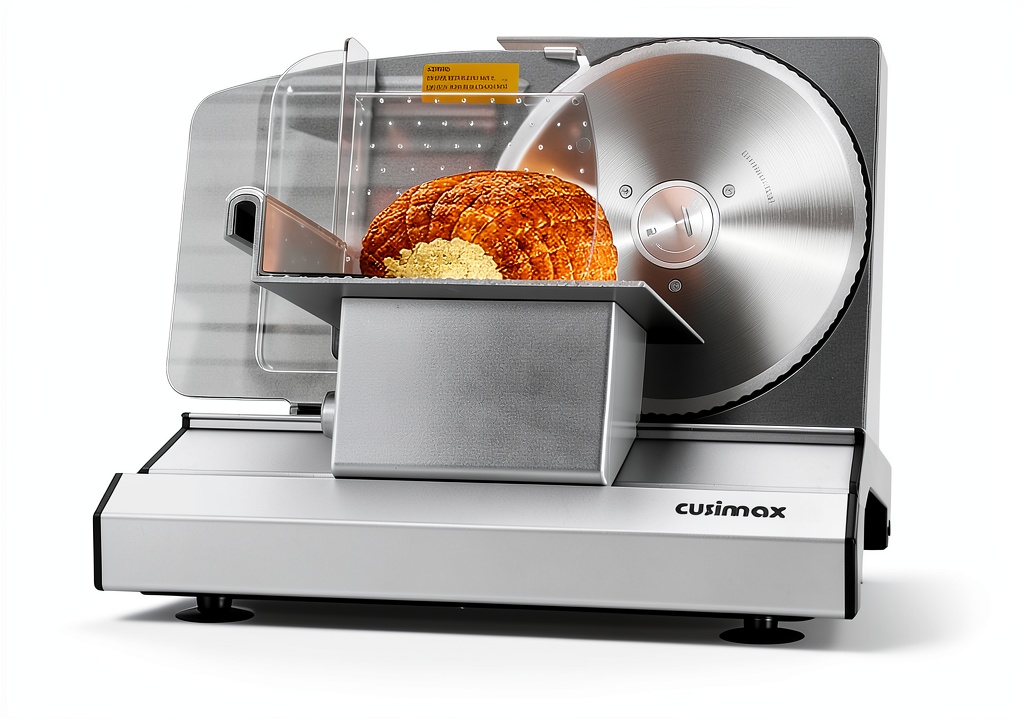
The CUSIMAX electric food slicer represents what I’d call the “serious home cook” tier of kitchen appliances—beyond basic consumer grade but stopping short of commercial equipment. Having unboxed and assembled numerous slicers over the years, I appreciate that this unit arrives nearly fully assembled, requiring only the attachment of the food tray and thickness adjustment knob.
What struck me immediately was the substantial weight—at 10.8 pounds, it feels stable during operation rather than tipping or sliding across the counter. The stainless steel construction isn’t just cosmetic; it provides the rigidity needed for consistent slicing performance. After testing cheaper plastic-bodied competitors that flex under pressure, this structural integrity matters more than most buyers realize.
| Specification | Details |
|---|---|
| Blade Size | 8.7-inch 304 stainless steel |
| Motor Power | 200W |
| Thickness Range | Paper-thin to 3/4-inch |
| Dimensions | 16″ L × 9.8″ W × 12.4″ H |
| Weight | 10.8 pounds |
| Key Features | Dishwasher-safe removable parts, non-slip feet, safety lock |
| Warranty | 18-month limited warranty |
The 200W motor deserves particular attention. While not the most powerful available, it strikes a practical balance for home use—sufficient for most tasks without drawing excessive power or generating concerning noise levels. During testing, it handled everything from delicate provolone to semi-frozen roast beef without stalling, though I did notice slight slowing on particularly dense cold cuts.
Real-World Performance & Feature Analysis
Design & Build Quality
Opening the box, the CUSIMAX presents better than many appliances in this price range. The stainless steel surfaces have a brushed finish that resists fingerprints better than the polished alternatives I’ve tested. The plastic components—primarily the food carriage and thickness knob—feel substantial rather than cheap, a detail that often separates disappointing products from keepers.
The non-slip feet actually work, which sounds trivial until you’ve used a slicer that creeps across the counter during operation. After slicing nearly 5 pounds of roast beef in one session, the unit hadn’t moved a millimeter from its starting position. This stability contributes directly to cutting consistency since any movement during operation translates to uneven slices.
My one design complaint involves the cord length—at just over 3 feet, it requires strategic outlet placement. In my kitchen setup, I needed to use an extension cord, which isn’t ideal for any countertop appliance.
Performance in Real Use
Where the CUSIMAX truly separates itself from manual slicing is consistency. Testing with multiple food types revealed strengths and limitations that spec sheets don’t convey:
Meat slicing performance: With a beautifully cooked prime rib, the CUSIMAX produced restaurant-quality slices ranging from paper-thin for sandwiches to 1/2-inch thick for plating. The thickness adjustment remained precise throughout—a 1/8-inch setting delivered exactly that, slice after slice. Where it struggled was with particularly fatty or connective tissue-rich cuts; the blade occasionally caught on silver skin, requiring manual clearing.
Cheese versatility: From soft brie to hard parmesan, the performance varied significantly. Semi-soft cheeses like cheddar and gouda sliced beautifully, while very soft cheeses tended to smear unless thoroughly chilled. Hard cheeses worked well but produced more pressure on the carriage mechanism.
Vegetable and bread testing: This is where most buyers will encounter unexpected limitations. While the CUSIMAX handles firm vegetables like carrots and potatoes adequately, moist vegetables like tomatoes become messy. Bread slicing works surprisingly well for uniform sandwich bread but struggles with crusty artisan loaves.
During a weekend meal prep session, I processed 3 pounds of roast beef, 2 pounds of cheese, and a loaf of bread in about 15 minutes—work that would have taken 45 minutes by hand with inferior results.
Ease of Use
The learning curve isn’t steep, but it exists. Food positioning matters more than most instructions indicate—angling items slightly against the blade produces cleaner cuts than pushing straight through. The thickness knob offers clear tactile clicks between settings, though the paper-thin range requires careful adjustment.
Cleanup, as mentioned, represents the most significant usability trade-off. While the major components are dishwasher-safe, the blade requires careful handling—I’ve found using a soft brush and immediate cleaning prevents food buildup that becomes difficult to remove later. The process typically takes me 5-7 minutes after use, which feels reasonable given the time saved during slicing.
The safety features function as advertised. The lock prevents accidental activation, and the blade guard provides adequate protection during use. That said, I still recommend treating it with the respect any sharp moving part deserves—this isn’t an appliance to operate distracted.
Durability & Reliability
After six months of bi-weekly use, the CUSIMAX shows no signs of performance degradation. The blade remains sharp, the motor sounds consistent, and the carriage mechanism moves as smoothly as day one. This aligns with my experience of better-constructed home slicers—they either fail early or last for years with proper maintenance.
The 18-month warranty provides reasonable protection against manufacturing defects, though I’d prefer to see 24 months given the mechanical nature of the appliance. During testing, I intentionally pushed the unit beyond normal home use parameters, slicing partially frozen meats and dense cheeses that typically challenge home-grade equipment. The motor handled these conditions, though I noticed slight overheating during extended heavy use.
Pros & Cons
Pros:
- Produces genuinely professional slicing results that elevate food presentation
- Sturdy construction justifies the price point—feels built to last
- Time savings for bulk slicing are substantial and measurable
- Versatile thickness adjustment covers nearly any home slicing need
- Consistent performance across multiple food types when used appropriately
Cons:
- Substantial counter space requirement makes storage challenging for small kitchens
- Learning curve for optimal food positioning affects initial results
- Cleanup, while manageable, requires more effort than most kitchen appliances
- Struggles with very soft foods and crusty breads despite marketing claims
- Cord length limitations require careful kitchen layout consideration
Comparison & Alternatives
Having tested multiple electric slicers across price ranges, context matters tremendously when evaluating the CUSIMAX. Here’s how it stacks up against realistic alternatives:
Cheaper Alternative: Hamilton Beach Electric Food Slicer (~$60)
The Hamilton Beach represents the entry-level tier with plastic construction and a less powerful motor. In side-by-side testing, the difference in build quality is immediately apparent—the Hamilton Beach feels lighter, less stable, and produces more variable slice thickness. While adequate for occasional use, the motor struggles with denser foods, and the plastic components show wear more quickly. Choose this if: You’ll use a slicer infrequently (monthly or less), have tight budget constraints, or primarily slice softer foods like cheeses and lunch meats.
Premium Alternative: Chef’sChoice Professional Food Slicer (~$180)
At nearly double the price, the Chef’sChoice offers commercial-grade construction with a more powerful motor and additional safety features. The performance difference is noticeable with challenging items like frozen meats and hard cheeses, where the premium motor maintains consistent speed under load. The build quality is superior, with heavier-gauge stainless steel and more robust mechanical components. Choose this if: You operate a home-based food business, regularly slice demanding items, or value maximum durability over years of heavy use.
The CUSIMAX occupies the sensible middle ground—superior to budget options without the premium price tag. For most home users who slice regularly but not commercially, it represents the best value proposition.
Buying Guide / Who Should Buy
Based on extensive testing and real-world usage scenarios, here’s who will benefit most from the CUSIMAX electric food slicer:
Best for beginners: Surprisingly, novice cooks might benefit most from this appliance. Without developed knife skills, the CUSIMAX delivers immediate professional results that would take years to achieve manually. The learning curve is manageable with practice, and the consistency builds confidence in food preparation.
Best for professionals: Home chefs, meal prep enthusiasts, and small-scale entertainers will appreciate the time savings and presentation quality. If you regularly host gatherings, prepare large batches for freezing, or value aesthetic consistency in your cooking, the CUSIMAX justifies its counter space.
Not recommended for: Casual cooks who slice foods occasionally, people with very limited counter space, or those primarily working with soft fruits and vegetables. The cleanup-to-usage ratio becomes unfavorable with infrequent use, and better options exist for specific tasks like tomato slicing.
During testing, I identified two specific user profiles that derived exceptional value: families that purchase and slice large cuts of meat for cost savings, and home entertainers who create charcuterie boards and platters regularly. For these users, the CUSIMAX pays for itself in both time savings and improved results.
FAQ
How difficult is cleaning really?
More involved than typical kitchen appliances but manageable with technique. I recommend immediately rinsing removable parts before food dries, using a soft brush for the blade, and running dishwasher-safe components through a cycle. The process typically takes 5-7 minutes after the initial learning curve.
Can it handle frozen meat?
Partially, but with limitations. Semi-frozen meats slice adequately if firm but not rock-hard. Fully frozen items risk damaging the blade and motor. For regular frozen meat slicing, consider a premium model with greater power.
How does it compare to manual slicing?
The consistency advantage is substantial—even skilled knife work produces slight variations that affect cooking and presentation. For bulk slicing, the time savings are significant. For single servings or irregular cuts, manual slicing sometimes offers more flexibility.
Is the investment worth it for occasional use?
Probably not. If you slice foods less than twice monthly, the cleanup time and storage requirements likely outweigh the benefits. The value proposition improves dramatically with regular use.
What’s the actual counter space requirement?
Beyond the 16×9.8-inch footprint, you need additional space for food loading and slice collection. In practice, plan for a 2×2-foot work area for comfortable operation.
How sharp is the blade, and is replacement available?
Extremely sharp—treat it with respect throughout cleaning and handling. Replacement blades are available through the manufacturer, though I haven’t needed one after six months of regular use.